


There’s a very specific kind of frustration that comes with feeding a cat.
It usually starts on a high note: you finally find a food your cat actually eats without hesitation. You buy it again, maybe even in bulk, relieved that this small daily struggle has been solved. And then, just as quickly as it began, it ends. The same food that was enthusiastically devoured yesterday is now met with a brief sniff and quiet rejection, as if it has somehow lost all value overnight.
It’s easy to interpret this as pickiness or attitude—something inherently “cat-like” and mildly inconvenient. But according to a recent study, what’s really happening has less to do with personality and more to do with perception.
When Familiar Becomes Forgettable
The study, conducted by researchers at Iwate University in Japan and published in Physiology & Behavior, looked at something most cat owners experience but rarely question: why cats stop eating even when there’s still food left in the bowl.
In a series of controlled experiments, 12 cats were fed in repeated cycles—10 minutes of access to food, followed by a short break, repeated several times. What the researchers observed was surprisingly consistent: when the same food was offered over and over again, the cats gradually ate less with each round, even though they weren’t actually full.
But when something changed—even slightly—the behavior shifted.
Introducing a different food brought their appetite back almost immediately. And even more interestingly, the same effect happened when the food itself stayed the same, but the smell changed.
It’s Not About Hunger. It’s About Smell
At the center of this research is a concept called olfactory habituation—a process where the brain gradually stops responding to a smell after repeated exposure.
In simple terms, your cat isn’t rejecting the food because it’s bad.
They’re rejecting it because their brain has stopped finding it interesting.
Cats rely heavily on scent when evaluating food—far more than humans do, with a sense of smell that’s significantly more sensitive than ours. Once a smell becomes too familiar, it essentially fades into the background.
And when something new is introduced—even just a different aroma—the system resets. Appetite returns. Interest comes back online.
A Matter of Instinct, Not Attitude
Seen through this lens, the behavior starts to feel less like stubbornness and more like instinct.
Cats evolved as hunters, eating small, varied prey throughout the day rather than repeating the same meal over and over. The study suggests that this modern-day “food boredom” may actually be tied to that same biological wiring—an internal drive toward sensory variety.
So when your cat suddenly refuses a food they loved yesterday, it isn’t necessarily a sign that something is wrong. It may simply mean that, on a sensory level, the experience no longer holds their attention.
Small Changes, Noticeable Difference
The takeaway here isn’t that you need to constantly switch brands or reinvent your cat’s diet. In many cases, subtle changes are enough.
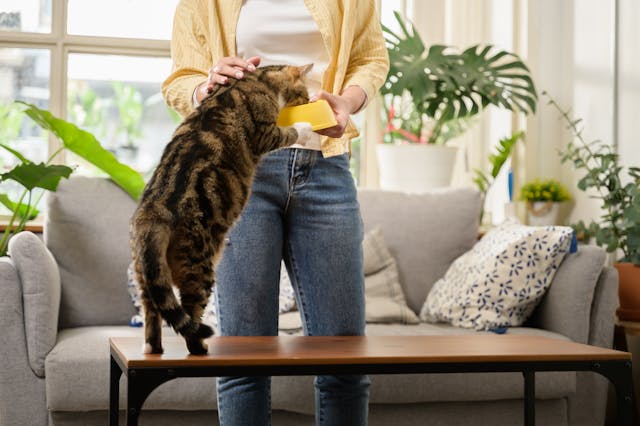
Warming the food slightly can release more aroma. Mixing in a small variation—whether in texture or flavor—can make the experience feel new again. Even something as simple as rotating between a few options can help maintain interest over time.
There’s also one detail that often gets overlooked: lingering smells. A bowl that hasn’t been properly cleaned can carry old odors that affect how appealing the food feels. And if there’s one thing this research makes clear, it’s that your cat notices smell more than you do.